
Minneapolis Assault Attorney
Hire an Attorney with Experience & Success Handling Assault Cases in Minneapolis
Most assault cases don't start as crimes. They start as arguments, misunderstandings, or situations that got out of hand in a matter of seconds. But once police are involved and a report is written, the system treats the situation like a finished story. Prosecutors file charges based on that report, and suddenly you're the defendant.
At Lushanko Law, we defend people facing assault charges at every level, from fifth-degree misdemeanors to first-degree felonies. We review the evidence the prosecution is relying on, look for gaps in the investigation, and build a defense around the facts of what actually happened. Not what the police report says happened.
If you were arrested or charged with assault in Minneapolis, contact Lushanko Law today for a free consultation.
Direct Access to Your Attorney
5-Star Rated on Google
Free Consultations
Request a Free Consultation.
Charged With Assault in Minneapolis? What You Do Next Matters.
If you're reading this shortly after an arrest or an incident, here are a few things to keep in mind right now.
Do not give a statement or try to "explain your side" to the police. Anything you say will be used to build the case against you, even if you believe it helps. Officers are trained to get statements that support charges, not to gather exculpatory information.
Understand that prosecutors can pursue charges even if the other person doesn't want to press them. In Minnesota, the charging decision belongs to the prosecutor, not the alleged victim. "They don't want to press charges" is not a defense, and it's not a guarantee that the case goes away.
Assault cases frequently turn on witness credibility, conflicting accounts, and questions of intent. The earlier an attorney can review the reports, identify inconsistencies, and preserve evidence (surveillance footage, text messages, 911 audio), the better.
Don't wait for your court date to start building a defense. Call Lushanko Law now.
Minnesota Assault Charges: Degrees, Penalties, and What They Mean
Minnesota classifies assault into five degrees. Fifth degree is the least severe. First degree carries some of the heaviest penalties in the criminal code. The degree depends on the severity of injury, whether a weapon was involved, and who was allegedly assaulted.
5th Degree Assault
Under MN statute 609.224, a first time 5th Degree Assault is a misdemeanor offense that carries a maximum penalty of 90 days in jail and a $1,000 fine. However, if you commit a 5th degree assault on the same person within 10 years, you may be charged with a gross misdemeanor or felony. You could be charged with a 5th Degree Assault if you do either of the following:
Commit an act to intentionally cause another person fear of bodily harm or death; or
Intentionally inflict or attempt to inflict bodily harm upon another person.
To be charged with a 5th Degree Assault, it is not necessary that you actually hit another person or make contact with them. You may be charged with a 5th Degree Assault for simply intending to make someone believe that you are going to hit them or make contact with them. For example, if you pull your hand back as if you are going to hit someone and you do this to make them believe you are going to hit them and hurt them, you could be charged with 5th Degree Assault.

4th Degree Assault
Under MN statute 1609.2231, a 4th Degree Assault may either be a gross misdemeanor or felony level offense depending on the circumstances. The maximum penalties for this offense range from 364 days in jail and a $3,000 fine to three years in prison and a $6,000 fine. Whether you can be charged with a 4th Degree Assault is dependent upon the person you are alleged to have assaulted. This offense primarily covers assaults committed against government employees. Below are a few ways you may be charged with a 4th Degree Assault:
Physically assaulting a peace officer while committing a lawful arrest or executing any other duty imposed by law. (Gross Misdemeanor - 364 days jail, $3,000 fine).
Physically assaulting a peace officer and causing demonstrable bodily harm. (Felony - 3 years prison, $6,000 fine).
Intentionally throwing or transferring bodily fluids onto a peace officer. (Felony - 3 years prison, $6,000 fine).
Assaulting and causing demonstrable bodily harm to a firefighter, emergency medical services personnel, physician, nurse, or any other person providing health care services. (Felony - 2 years prison, $4,000 fine).
Assaulting and causing demonstrable bodily harm to a correctional officer, prosecutor, judge, or probation officer. (Felony - 2 years prison, $4,000 fine).
Intentionally throwing or transferring bodily fluids onto a correctional officer, prosecutor, judge, or probation officer. (Felony - 2 years prison, $4,000 fine).
“Demonstrable bodily harm” is harm that you can physically see, such as a bruise or a scratch. Note that this list does not include every scenario in which a person can be charged with a 4th Degree Assault. There are many other government employees that also fit under this list.

3rd Degree Assault
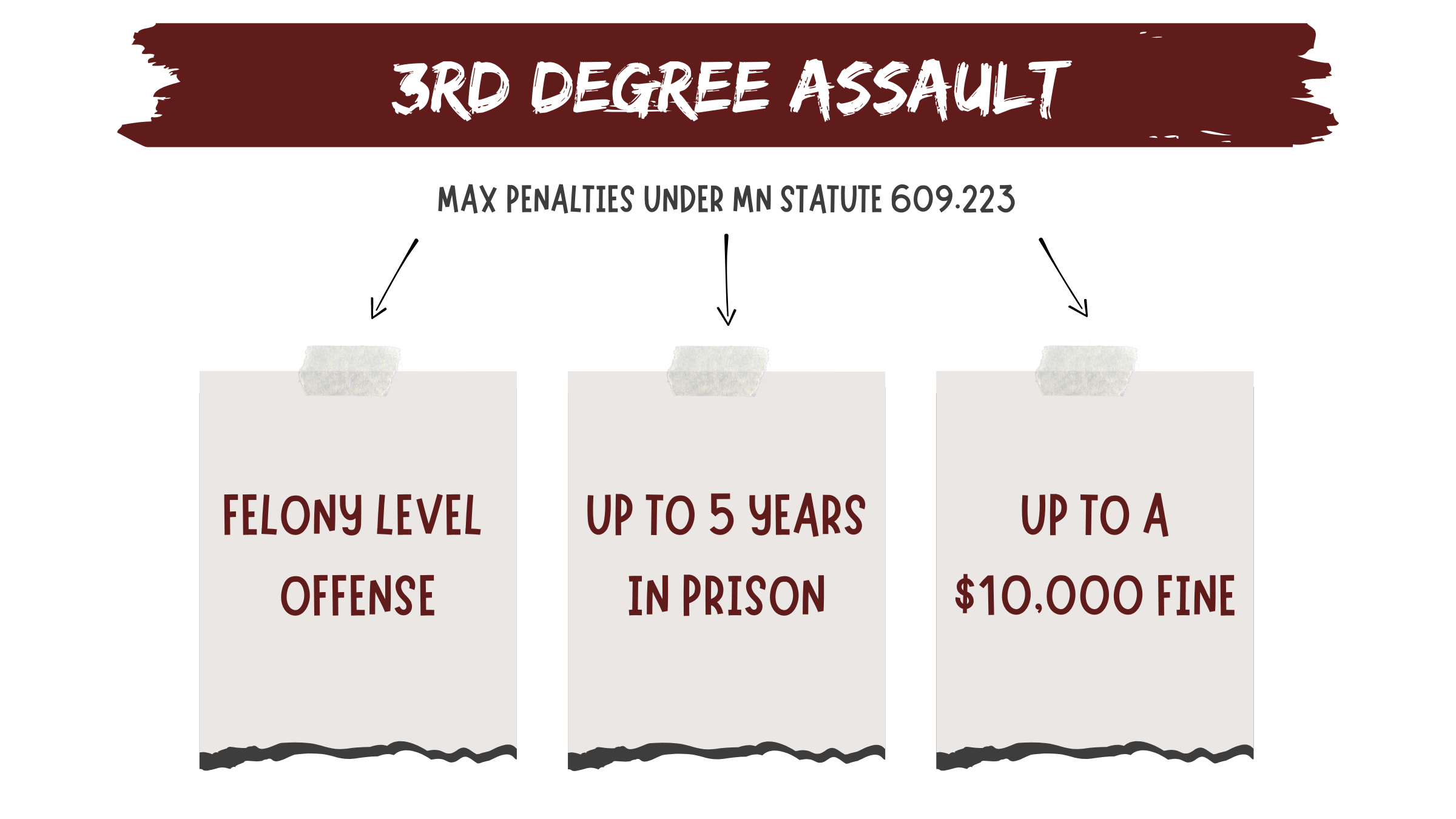
Under MN statute 609.223, a 3rd Degree Assault is a felony level offense that carries a maximum penalty of 5 years in prison and a $10,000 fine. You may be charged with a 3rd Degree Assault for committing the following actions:
Assaulting another person and causing them substantial bodily harm.
Assaulting a minor and there is a past pattern by the Defendant of child abuse against the minor.
Assaulting a child under the age of 4 and causing bodily harm to their head, eyes, or neck, or otherwise causing multiple bruises to the child’s body.
“Substantial bodily harm” is harm that causes temporary but substantial disfigurement, or causes a temporary but substantial loss or impairment of the function of any bodily member or organ, or causes a fracture of any bodily member. A broken bone is an example of substantial bodily harm in Minnesota.
2nd Degree Assault
Under MN statute 609.222, a 2nd Degree Assault is a felony level offense that carries a maximum punishment ranging from 7 years in prison and a $14,000 fine to 10 years in prison and a $20,000 fine. Below are actions that may cause you to be charged with 2nd Degree Assault:
Assaulting another person with a dangerous weapon. (7 years in prison, $14,000 fine).
Assaulting another person with a dangerous weapon and causing substantial bodily harm. (10 years in prison, $20,000 fine).
A “dangerous weapon” includes any devices designed as a weapon that is capable of producing death or great bodily harm. It also includes any combustible or flammable liquid that is calculated or likely to produce death or great bodily harm. The obvious example of a dangerous weapon includes a firearm. Learn more about weapon offenses here.

1st Degree Assault
Under MN statute 609.221, a 1st Degree Assault is the highest level of Assault and carries the most severe penalties. It is a felony level offense and carries a maximum punishment ranging from 20 years in prison and a $30,000 fine to 30 years in prison and a $40,000 fine. You may be charged with a 1st Degree Assault if you commit the following actions:
Assaulting another person and causing them great bodily harm. (20 years prison, $30,000 fine).
Assaulting a peace officer, prosecuting attorney, judge, or correctional employee by using or attempting to use deadly force. (20 years prison, $30,000 fine).
Assaulting a peace officer, prosecuting attorney, judge, or correctional employee and causing them great bodily harm. (25 years prison, $35,000 fine).
Assaulting a peace officer, prosecuting attorney, judge, or correctional employee with a deadly weapon and causing great bodily harm or using or attempting to use deadly force with a dangerous weapon. (30 years prison, $40,000 fine).
“Great bodily harm” means bodily injury that creates a high probability of death, serious permanent disfigurement, or a permanent or protracted loss or impairment of the function of any bodily member or organ. For example, permanent scarring or the loss of a limb would be considered great bodily harm. The main difference between “substantial bodily harm” and “great bodily harm” is that great bodily harm is a permanent injury while substantial bodily harm is a temporary injury.

Common Defenses to Assault Charges in Minnesota
Assault cases are rarely as clean as the police report makes them sound. They typically involve conflicting stories, incomplete evidence, and situations where the full picture looks very different from the one the officer documented at the scene.
Self-Defense or Defense of Another Person
Minnesota law recognizes the right to use reasonable force to defend yourself or someone else from an immediate threat. The key questions are whether you reasonably believed force was necessary and whether the force you used was proportional. In our experience, self-defense applies to more cases than clients initially realize, particularly when the alleged victim was the initial aggressor.
False or Exaggerated Allegations
Someone calls the police out of anger, spite, or a desire to gain leverage in a custody dispute. By the time officers arrive, the story they hear is one-sided. These cases live and die on credibility, and careful investigation into the accuser's motives, prior statements, and behavior patterns can change the trajectory of a case.
Lack of Intent
Assault in Minnesota requires intentional conduct. Accidental contact, instinctive reactions, and situations where you simply didn't intend to cause harm or fear all fall outside the statute. Prosecutors have to prove intent beyond a reasonable doubt, and "something happened" is not the same as "they meant to do it."
Mistaken Identity
Bar fights, large gatherings, poorly lit parking lots. In chaotic situations, witnesses and even alleged victims sometimes point to the wrong person. If the identification is shaky, the case built on it is shaky too.
Mutual Combat and Unclear Aggressor
When two people are in a physical confrontation, the question of who started it matters. If the evidence doesn't clearly establish who the aggressor was, the state has a problem proving its case against either person specifically.
Weak or Inconsistent Witness Testimony
Witnesses change their stories. They remember details differently a week later than they did on the night it happened. They have relationships with the parties involved that color what they report. When the state's case leans heavily on witness accounts, pulling those accounts apart is where the real work happens.
Constitutional Violations
If your rights were violated during the investigation, arrest, or interrogation, the evidence that resulted from those violations may be subject to suppression. That includes statements, physical evidence, and identification procedures conducted improperly.
An assault charge reflects the state's theory. The question is whether the evidence actually supports it.
After arrest, you may go through booking at the Hennepin County jail. Depending on the charge level and circumstances, you may be held until a bail hearing where you will be released on your own recognizance or required to post bail.
Your first court appearance (arraignment or first appearance) will typically be scheduled within a few days if you are in custody, or a few weeks if you are out of custody. At that appearance, you'll be formally advised of the charges and the court will set conditions of release.
Felony assault cases in Minneapolis are prosecuted by the Hennepin County Attorney's Office. Non-felony cases may be handled by the Minneapolis City Attorney or county prosecutors depending on the circumstances. Either way, the case will proceed through Hennepin County District Court.
From there, the case enters a pretrial phase: discovery (where both sides exchange evidence), motions (where legal issues are argued), and negotiations. If a resolution can't be reached that serves your interests, the case goes to trial.
Having an attorney involved early keeps you from making concessions or mistakes during this process that are difficult to reverse later.
What Happens After an Assault Arrest in Minneapolis
Consequences Beyond Jail and Fines
The consequences of an assault conviction go beyond just statutory penalties. If convicted, you can expect the following:
A criminal record visible on every background check an employer, landlord, or licensing board runs on you.
Loss of firearm rights under both Minnesota and federal law. Certain assault convictions trigger prohibitions under the Lautenberg Amendment that are extremely difficult to reverse.
Employment problems that compound over time. A conviction can disqualify you from industries involving security clearances, vulnerable populations, or professional licensing, and that disqualification doesn't expire when probation does.
Landlords often screen for criminal records, and an assault conviction narrows your options in ways that affect where you can live for years.
Immigration consequences for non-citizens. Assault convictions classified as crimes involving moral turpitude or aggravated felonies can trigger removal proceedings or block applications for status adjustment.
These are not hypothetical concerns. They're the reasons our clients pick up the phone.
Frequently Asked Questions About Assault Charges in Minneapolis
-
No. The charging decision belongs to the county or city attorney. Prosecutors regularly move forward over the objection of the alleged victim. The other person's wishes may carry some weight during negotiations, but they don't usually control whether the case proceeds.
-
Yes. One thing worth noting: self-defense doesn't require that you were actually in danger. It requires that you honestly believed you were in imminent danger and a reasonable person in your situation would have shared that belief. That's an important distinction, and it opens the defense to more fact patterns than people expect.
-
Yes, unless you petition for and receive an expungement. Minnesota allows expungement of certain records, but eligibility depends on the offense level, the case outcome, and how much time has passed. Until a record is expunged, it appears on background checks.
-
You'll be formally advised of the charges, and the court will set release conditions, and may set bail. In many assault cases, those conditions include a no-contact provision. It is not common for your case to resolve at this stage.
-
Sometimes. Depending on the evidence and the circumstances, assault charges can be negotiated down to disorderly conduct or another lesser offense, or dismissed entirely. The leverage available depends on the specific weaknesses in the state's evidence and the context of what allegedly happened.
-
Collaborative, honest, and straightforward. We're here to guide the process, bring ideas to the table, and keep things moving.