Minneapolis DWI Attorney
Hire an Experienced DWI Attorney with a History of Success

In the state of Minnesota, it is illegal to drive, operate, or be in physical control of a motor vehicle while under the influence of alcohol, marijuana, and/or a controlled substance. If you are arrested for Driving While Impaired (DWI) in Minneapolis, both a criminal case and an administrative license process are triggered at the same time. These are two separate proceedings, each with its own rules, deadlines, and consequences. The administrative process—often referred to as implied consent—can result in the loss of your driving privileges on a completely different timeline than your criminal case. Many people are unaware that these processes run in parallel until they have already missed critical deadlines in one or both.
At Lushanko Law, we dig into the specifics: the reason for the stop, how field testing was conducted, the reason for the arrest, whether the officer followed chemical testing protocol, and whether the test was reliable. That's where weak spots in the prosecution's case tend to hide.
If you were arrested for DWI in Minneapolis, contact Lushanko Law today to schedule a free consultation. The earlier we review your case, the more options are on the table.
Minnesota DWI Charges and Penalties
Minnesota classifies DWI offenses by degree. The degree depends on aggravating factors: prior impaired-driving incidents, the driver's alcohol concentration at the time of testing, and whether there was a child in the vehicle. The more factors present, the more serious the charge.
Under Minnesota statute chapter 169A, Driving While Impaired (DWI) offenses are categorized into four different degrees, each carrying varying levels of severity. A 1st degree DWI offense carries the most severe punishments whereas a 4th degree DWI results in the least severe penalties.
Minnesota DWI Charges and Penalties
Minnesota classifies DWI offenses by degree. The degree depends on aggravating factors: prior impaired-driving incidents, the driver's alcohol concentration at the time of testing, and whether there was a child in the vehicle. The more factors present, the more serious the charge.
Under Minnesota statute chapter 169A, Driving While Impaired (DWI) offenses are categorized into four different degrees, each carrying varying levels of severity. A 1st degree DWI offense carries the most severe punishments whereas a 4th degree DWI results in the least severe penalties.
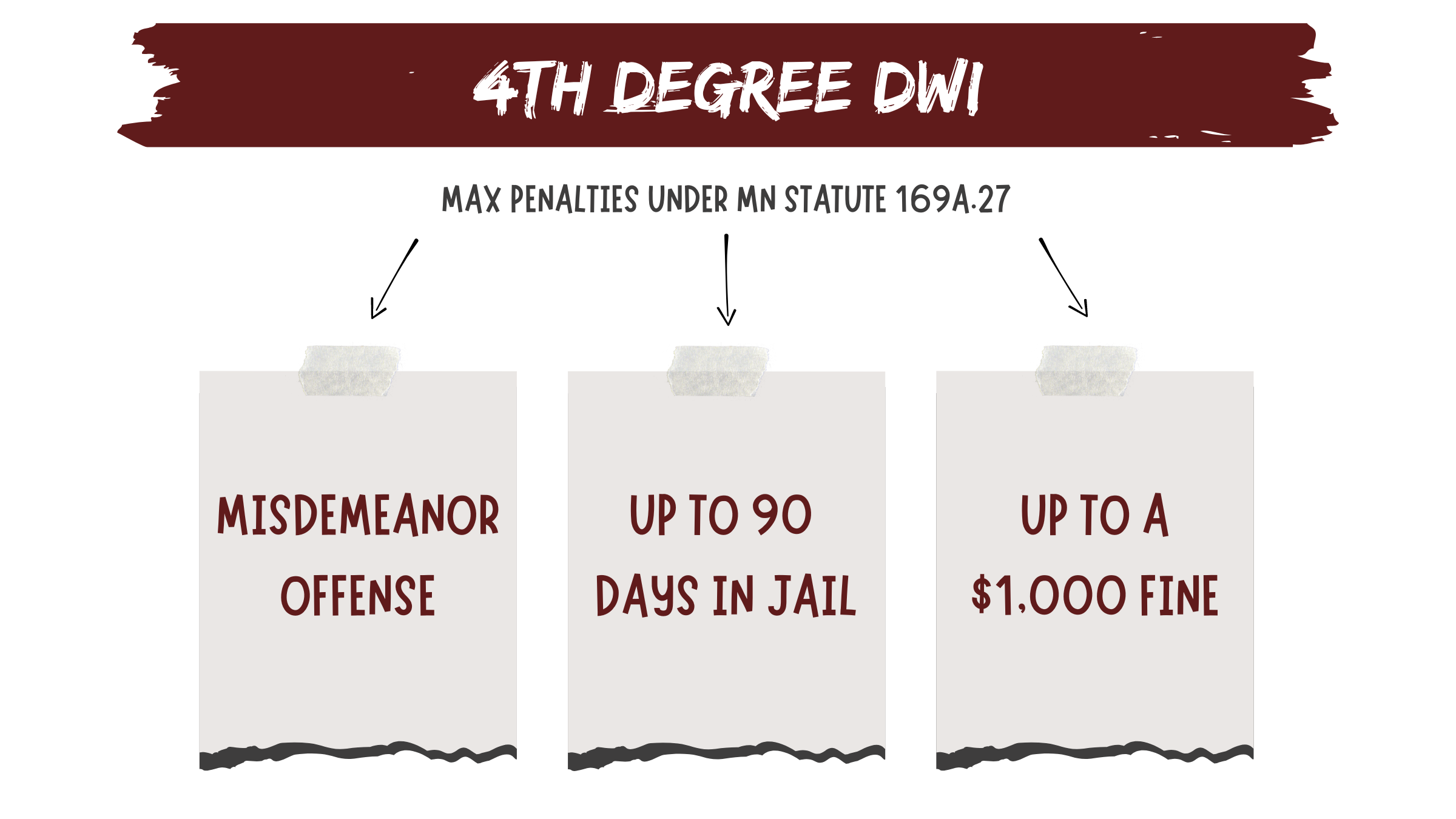
4th Degree DWI
Under MN statue 169A.27, a 4th Degree DWI is a misdemeanor offense that carries a maximum punishment of 90 days in jail and a $1,000 fine. You could be charged with a 4th Degree DWI if:
You are driving, operating, or in physical control of a motor vehicle while:
Under the influence of alcohol (no matter your blood alcohol concentration level).
Under the influence of a controlled substance.
Under the influence of any other intoxicating substance.
Under the influence of any combination of alcohol and an intoxicating substance.
Having a blood alcohol concentration level of .08 or higher within two hours of driving.
Having a blood alcohol concentration level of .04 or higher in a commercial vehicle within two hours of driving.
Having any amount of a Schedule I or II controlled substance in your system, or its metabolite, aside from THC or marijuana.
3rd Degree DWI
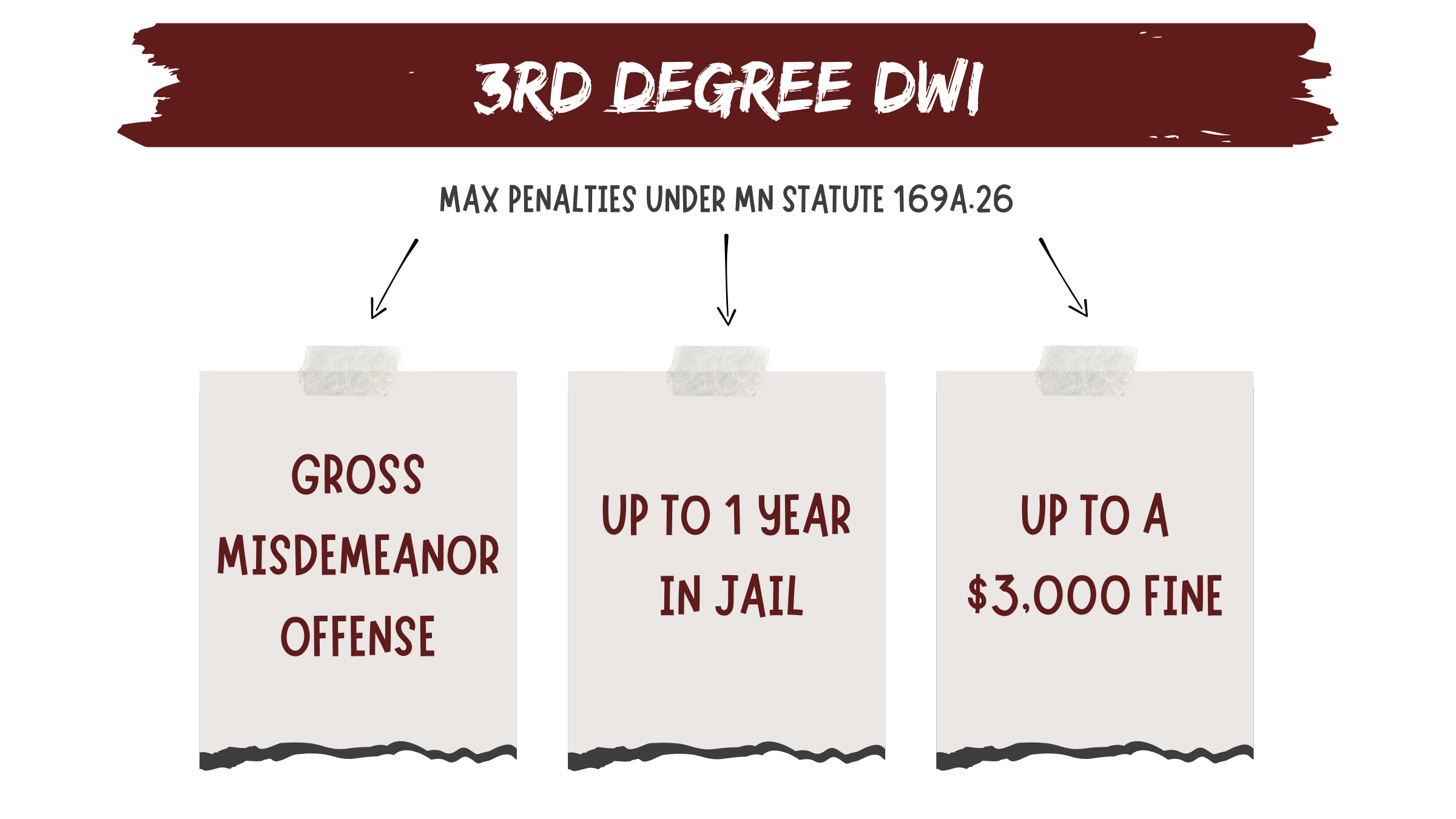
UnderMN statue 169A.26, A 3rd Degree DWI is a gross misdemeanor offense that carries a maximum punishment of 1 year in jail and a $3,000 fine. You could be charged with a 3rd Degree DWI if:
You refuse to submit to a chemical test (breath, urine, blood test) for intoxication with no prior DWI convictions or license revocations due to alcohol within the past 10 years.
You commit any of the seven actions listed under 4th degree DWI with one of the following aggravating factors:
One prior DWI conviction or license revocation due to a DWI arrest within the last 10 years.
Having a blood alcohol concentration of .16 (double the legal limit) or higher within 2 hours of driving.
Having a person under the age of 16 in the vehicle.
2nd Degree DWI
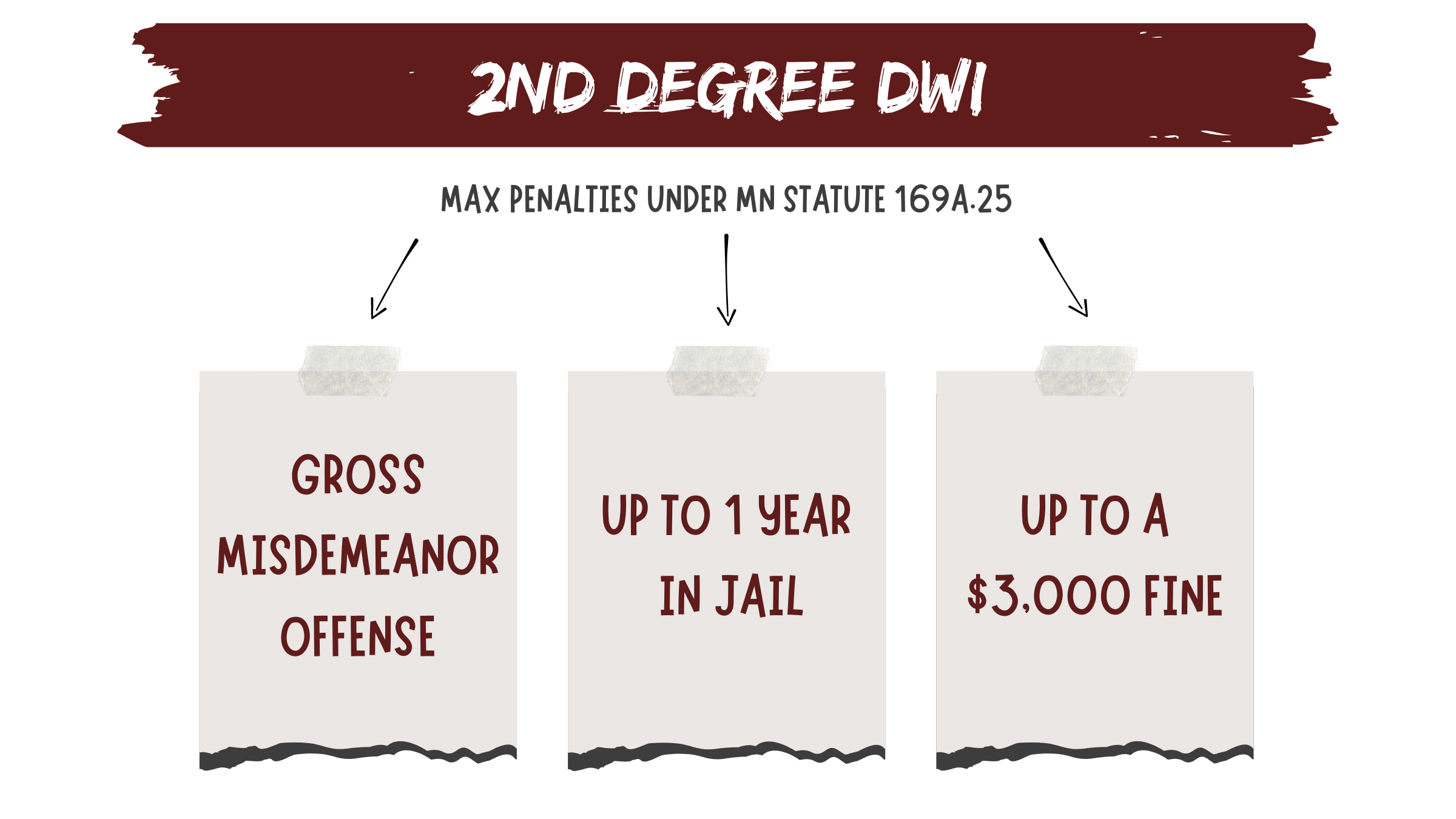
Under MN statue 169A.25, a 2nd Degree DWI is also a gross misdemeanor offense that carries the same maximum penalty as a 3rd Degree DWI. However, it is a more serious offense than a 3rd Degree DWI. You could be charged with a 2nd Degree DWI if:
You refuse to submit to a chemical test (breath, urine, blood test) for intoxication with one prior DWI conviction or license revocation due to alcohol within the past 10 years.
You commit any of the seven actions listed under 4th degree DWI with two aggravating factors listed under 3rd Degree DWI.
1st Degree DWI
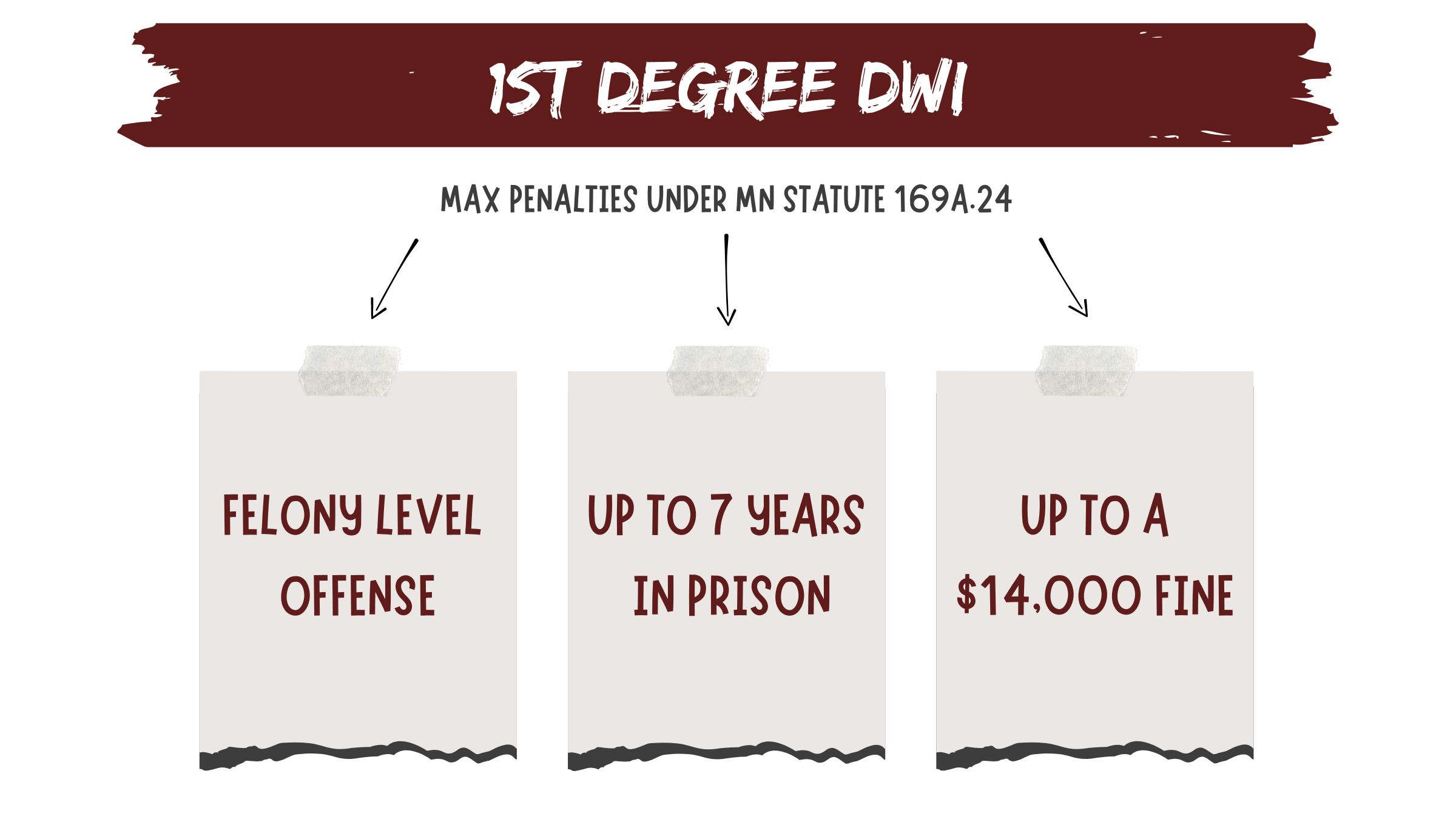
Under MN statue 169A.24, a 1st Degree DWI is a felony level offense and is the most serious DWI offense you can be charged with. The maximum penalty for a 1st Degree DWI is 7 years in prison and a $14,000 fine. You could be charged with a 1st Degree DWI if:
You refuse to submit to a chemical test (breath, urine, blood test) for intoxication with 3 prior DWI convictions or license revocations due to alcohol within the past 10 years OR a prior felony DWI conviction.
You commit any of the seven actions listed under 4th degree DWI with 3 prior DWI convictions or license revocations due to alcohol within the past 10 years OR a prior felony DWI conviction.
Additional Consequences of a DWI Conviction
Statutory penalties are only the beginning. A DWI conviction creates problems that outlast the court case itself:
License revocation lasting months or longer, even on a first offense.
Ignition interlock requirements that affect how (and whether) you drive.
Vehicle forfeiture in aggravated cases, meaning the state takes your car.
Employment fallout, particularly in jobs that require driving, security clearance, or a clean background check.
Professional licensing problems for nurses, teachers, CDL holders, healthcare professionals, attorneys, and other licensed professionals.
Insurance rate increases that can persist for years after the conviction.
A criminal record that shows up on background checks for employers, landlords, and licensing boards.
If you are charged with a DWI in the Twin Cities, you need an experienced attorney that will vigorously fight on your behalf to reach the best possible outcome. Contact Lushanko Law today at 952-818-6376 or fill out the online contact form below for a free consultation.
What To Do After a DWI Arrest in Minneapolis
Right now, two clocks are running. The criminal case will move through Hennepin County court on its own schedule. But the administrative side, specifically your driver's license, operates independently and often moves faster.
You may have received paperwork at the police station or jail. If any of it references your license or a notice of revocation, it sets a deadline you need to act on. More on that below.
On the criminal side, the prosecution will build its case around the traffic stop, the officer's observations, field sobriety testing, and chemical test results. Each of those steps have rules governing how they must be conducted. When those rules aren't followed, the evidence becomes vulnerable.
The single best thing you can do right now is get an attorney reviewing your case before any deadlines pass.
Don't wait for your court date to start thinking about representation. Call Lushanko Law now.
Will You Lose Your License? Minnesota Implied Consent and Revocation Deadlines
This is often the most urgent piece of a DWI case, and most people underestimate it. Your license can be revoked through the administrative process even if you haven’t been criminally charged yet, and it can remain revoked even if your criminal case is later reduced or dismissed.
What Is Minnesota's Implied Consent Law?
By driving on Minnesota roads, you've already agreed to submit to chemical testing (breath, blood, or urine) if an officer has lawful grounds to request it during a DWI investigation. That agreement is baked into the privilege of holding a Minnesota license. A test refusal, or a result at or above a blood alcohol concentration of 0.08, can trigger a revocation that runs on its own track, completely separate from any criminal penalties.
How Long Do You Have To Challenge a Revocation?
Once you receive a notice and order of revocation, which is usually given the day of the arrest, you have 60 days to file a petition for judicial review. That is a hard cutoff. If you miss it, the revocation stands, and you lose the chance to argue it was unjustified. This deadline alone is reason enough to call an attorney within days of your arrest.
Temporary Licenses and 2025 Law Changes
You will be given a temporary license for 14 days after a DWI-related revocation to figure out next steps, unless your driving privileges were already invalid at the time. Minnesota extended the temporary license period from 7 days to 14 days in 2025. If you're finding older information online that still references the 7-day window, it's outdated.
Between the temporary license window, potential ignition interlock requirements, and the 60-day judicial review deadline, the administrative side alone has enough moving parts to trip up anyone trying to handle it without counsel.
The 60-day window for challenging your license revocation is firm. Contact Lushanko Law now so we can evaluate your options before time runs out.
Common Defenses to DWI Charges
An arrest is the beginning of a case, not the end of one. DWI investigations involve a chain of steps, and each step has rules that must be followed by law enforcement. When those rules aren't followed, the evidence that stemmed from them may be inadmissible in court. Here's where we focus our review.
Unlawful Traffic Stop
Police need a valid legal basis to pull you over. A hunch isn't enough. If the stop lacked reasonable suspicion of a traffic violation or criminal activity, the evidence that stemmed from it may be subject to suppression.
Unlawful Expansion of a Traffic Stop
Even after a lawful stop, the officer needs sufficient grounds to escalate into a full DWI investigation. Law enforcement cannot just order you out of the car and ask you to perform field sobriety tests without reason. If the facts on the ground didn't support that escalation, the expansion of the stop itself may be challengeable.
Field Sobriety Test Issues
Standardized field sobriety tests must be administered according to specific protocols, including how the tests are explained, conducted, and evaluated, as well as the conditions under which they are performed. Wind, uneven pavement, poor lighting, medical conditions, even inappropriate footwear can compromise the results. Officers are trained on these protocols. The question is whether they followed them.
Probable Cause to Arrest
Probable cause to arrest requires more than a mere hunch or suspicion—it requires facts and circumstances that would lead a reasonable officer to believe that a crime has been committed. Probable cause is typically based on the totality of the circumstances, including driving conduct, observations of impairment, and performance on field sobriety tests when administered. If these factors are not present, you may have a challenge for lack of probable cause to arrest.
Breath Test Advisory and Right to Counsel Issues
Before a chemical test is requested, law enforcement must accurately and clearly inform the individual that refusal is a crime and you have the right to talk to an attorney before deciding to take a test. Any ambiguity, misstatement, or omission in the advisory can become critical. Law enforcement must provide a meaningful opportunity to exercise your right to counsel, including access to a phone and a reasonable amount of time to talk. If officers fail to honor this right, the admissibility of the test result or refusal may be subject to challenge.
Breath, Blood, and Urine Testing Problems
Chemical testing is only as reliable as the process behind it. Calibration records, maintenance logs, the timing between arrest and testing, sample handling, and chain-of-custody documentation all matter. A result that looks damning on paper can unravel when the underlying procedure doesn't hold up.
Physical Control and Driving Issues
Not every DWI case involves someone driving down the road. Some involve a person sitting in a parked car. The legal question of whether someone was in "physical control" of a vehicle has its own set of standards, and it's a defense angle that gets overlooked more often than it should.
The point isn't that every case has a silver bullet. The point is that DWI cases are built on a sequence of procedures, and procedures are where mistakes happen.
Speak With a Minneapolis DWI Attorney Today
If you are charged with a DWI in the Twin Cities, you need an experienced attorney that will vigorously fight on your behalf to reach the best possible outcome. Contact Lushanko Law today at 952-818-6376 or fill out the online contact form at the bottom of the page for a free consultation.

Frequently Asked Questions
-
You'll typically be transported to a police station or jail for chemical testing. After testing, you may receive paperwork that includes a notice related to your driver's license. Pay close attention to dates on that paperwork. Depending on your circumstances, you could be released the same day or booked and held at a county jail. Your criminal case will be scheduled separately for an initial court appearance, usually within a few weeks.
-
In many cases, yes. The implied consent process can move forward regardless of what happens with the criminal charges. But revocations can be challenged through a petition for judicial review under strict timelines, which is why acting quickly after arrest matters so much.
-
60 days from the date on the notice and order of revocation. This is a hard deadline, not a suggestion. If it passes without a petition filed, the revocation stands.
-
A first-time DWI is usually charged as a fourth-degree misdemeanor, or 3rd or 2nd degree gross misdemeanor, depending on aggravating factors present. Don't mistake a first time DWI as an unserious offense. You're looking at a criminal record, license consequences, fines, possible jail time, and insurance rate hikes that can last for years. Having an attorney review your case can change the trajectory significantly.
-
Yes. A reading at or above .16 is an aggravating factor under Minnesota law. It can bump the degree of your charge, increase sentencing exposure, and trigger enhanced license consequences. It's one of the fastest ways a case escalates.
-
Refusal carries its own penalties, including license revocation and a criminal charge. It is also considered an aggravating factor in DWI cases. That said, refusal cases also open up defense questions about whether you actually refused, whether the officer had lawful grounds to request the test, or whether you reasonably refused due to confusion.
You can read more about this in our post here.
-
Yes. DWI cases are built on a chain of procedures: the reason for the stop, the field testing, the chemical test, the arrest decision. Each link in that chain has rules, and when those rules aren't followed, the evidence becomes vulnerable to challenge.
-
In certain aggravated situations, Minnesota law permits the state to seize and forfeit your vehicle. This typically comes into play with repeat offenses. It's not automatic, but it's a real risk under certain circumstances.
-
A first DWI can follow you for years through background checks, insurance costs, and professional licensing complications. An attorney who reviews your case early can identify defenses, protect your license, and give you a realistic picture of where things stand. Contact Lushanko Law for a case review.